Using machine learning to quickly find qualified talent
2023
The Mom Project
Visual Design/UI
User Research
Prototyping
User Experience
Design Strategy


Impact
Talent invited through this feature were 1.3x more likely to get an interview and 1.4x more likely to get hired.
Background
The Mom Project is a dual-sided marketplace for moms to find their next role with like-minded companies. Before this feature, matching candidates to open roles relied on a manual process: employers had to wait for applications to come in rather than proactively finding good-fit talent. Our goal was twofold: give employers direct, AI-powered recommendations, and replace that manual internal workflow with an automated system that could scale.
My role
I was the Lead Product Designer on this project.
My responsibilities included:
Collaboration on requirements, user stories, and iterations
Collaboration to develop success metrics
Decided how much recommendation logic to expose to users versus keep invisible, balancing trust with simplicity
Create conceptual designs, wireframes, high-fidelity designs, and prototypes
Lead user research strategy and executed unmoderated research
Created and established design system components
Design visuals for product marketing
Constraints
This was our first machine learning powered feature, which meant designing without an established pattern to follow. I had to translate unfamiliar recommendation logic into an experience employers and talent could trust, while working closely with the AI Engineering team to understand what was technically possible before committing to a direction. Executive buy-in wasn't guaranteed going in, which is part of why we invested early in a sizzle reel to align stakeholders on the vision before design work began. Partway through, a talent privacy policy limitation meant employers couldn't directly access candidate profiles, so the flow shifted to an invite-then-apply model instead of the more direct access we'd originally designed for.
The Design Process
Aligning on vision
I built a sizzle reel alongside a writer and product lead. This enabled us to communicate the vision and proposed feature's value to stakeholders and key partners to get buy-in.
Defining requirements
I partnered with the Product Manager to define user stories for both sides of the marketplace:
Employer: When my job goes live, I want to receive recommendations so I can invite strong candidates to apply. When I see a good fit, I want to invite them to apply.
Talent: When I'm a good fit for a job, I want to be recommended so I'm more likely to apply. When an employer invites me, I want to be notified quickly so I can act on it.
Mapping the workflow
I mapped the workflow across all three sides of the system: employer, talent, and the internal recommendation process being automated, to align product and engineering on how the new logic would replace manual matching. This became the blueprint for how the feature would function end-to-end, not just what employers and talent would see.

Workflow diagram mapping the recommendation logic across employer and talent flows.
Understanding the full system
Before this feature existed, I worked on an earlier project streamlining how the team sent shortlists of candidates to clients. The problem space came from several rounds of customer research. From there, I took part in internal research to understand how the team worked. I partnered closely with sales to understand where the process broke down for employers, and worked with the data science team to understand how candidates were weighted, research that later shaped the algorithm behind this feature's AI-driven recommendations.
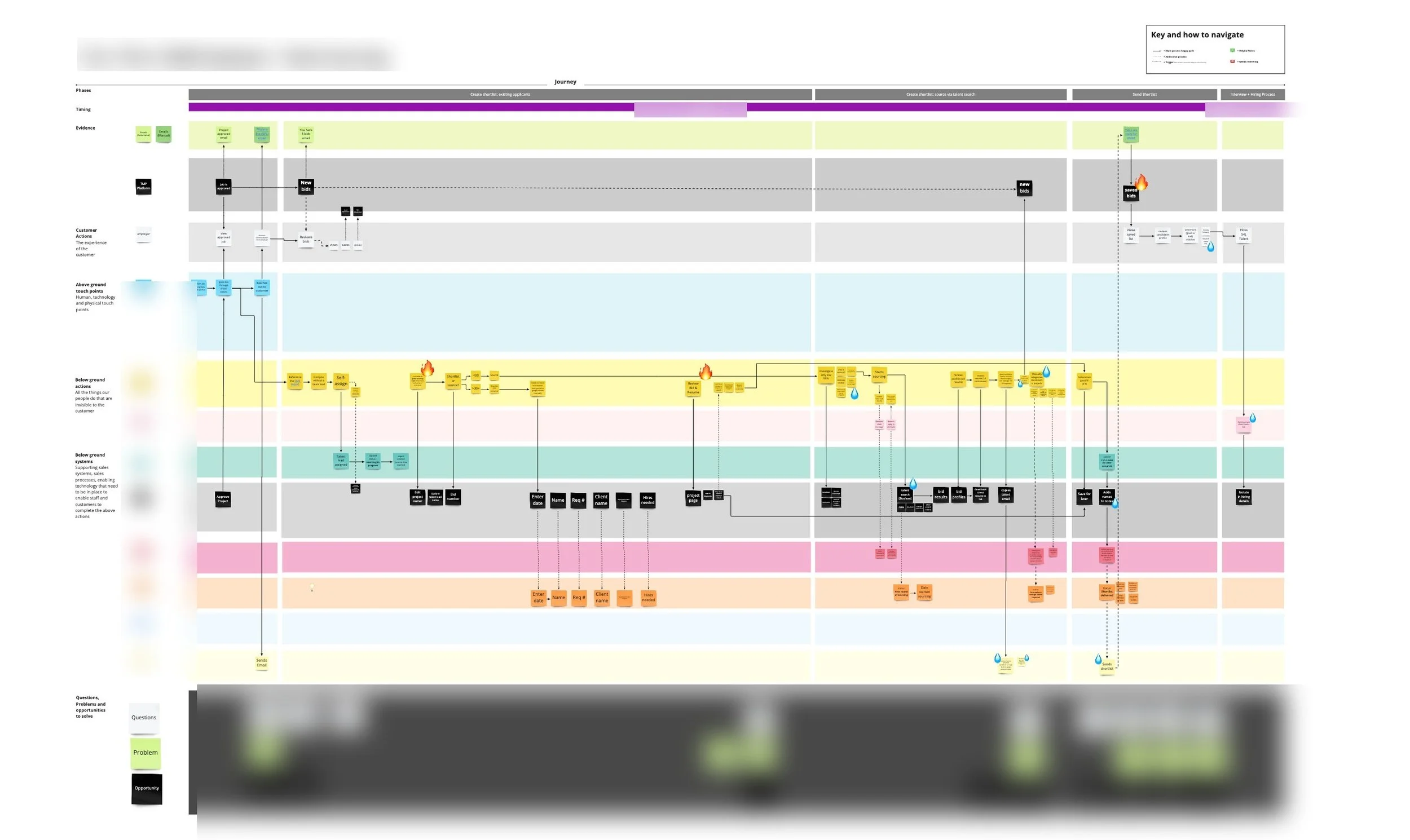
This blueprint mapped the employer sourcing journey across both customer-facing actions and the internal systems and handoffs supporting them, surfacing friction points that shaped the direction of this later feature.
User Research
I ran unmoderated research with both sides of the marketplace, testing the invitation process with prototypes, questions, and rating scales, to validate direction before finalizing designs. Key themes from employer research, used to guide the final invitation flow.

Synthesis board from unmoderated research sessions with employers
Finalizing the design
With research validated, I moved into high-fidelity design and product marketing to prepare the feature for launch. The design needed to make employers trust an unfamiliar system, AI-recommended candidates, without overwhelming them with the logic behind it. I addressed this by surfacing just enough context (why a candidate was a strong match) directly on the profile card, so employers could trust a recommendation at a glance rather than needing to understand the underlying model.


Messaging created to build trust in AI-driven recommendations before employers ever saw a candidate, setting expectations for what the feature does and why.
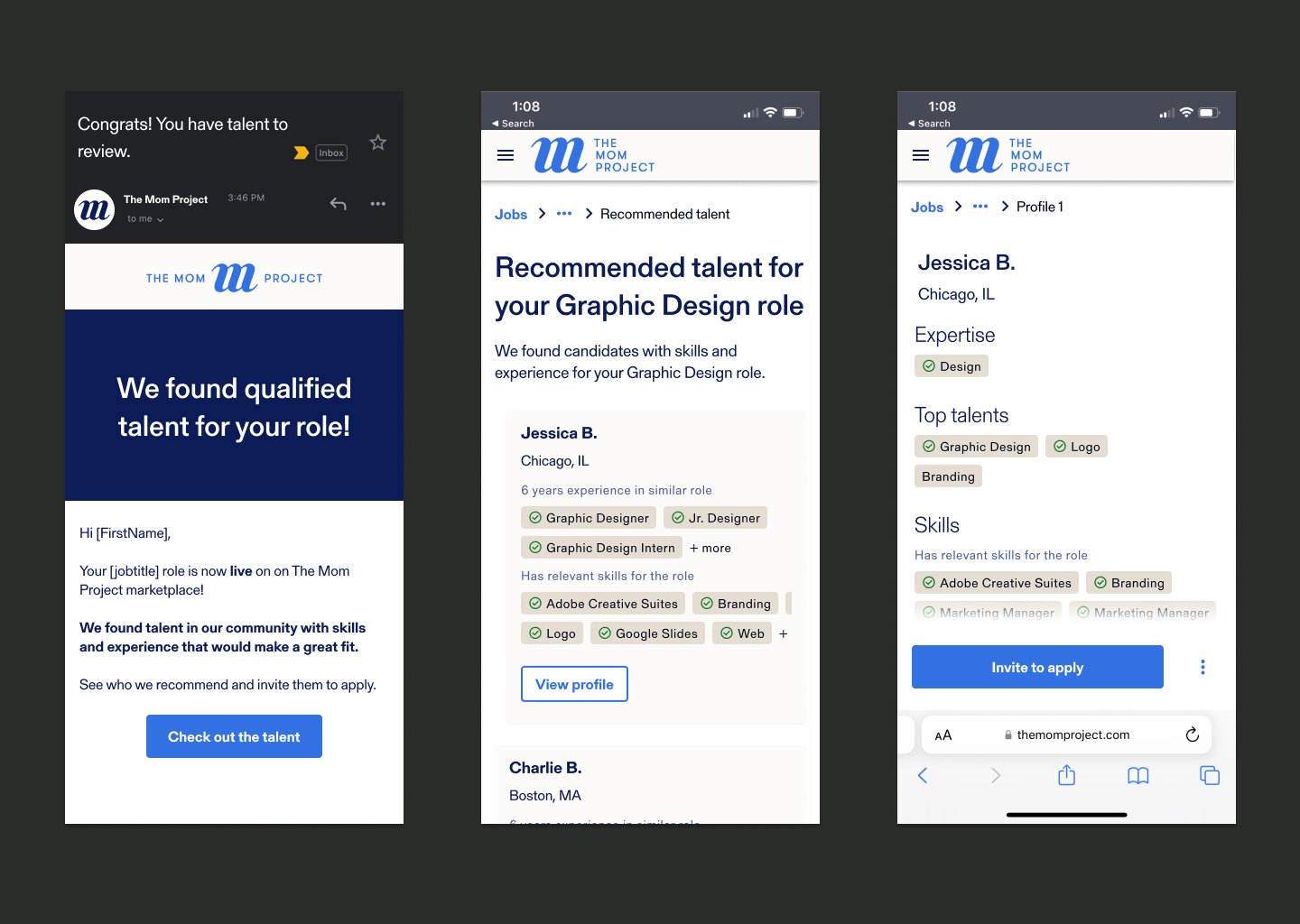

The mobile experience prioritized speed: employers needed to review and act on recommendations (invite or pass) in the moment, so actions are one tap away rather than buried in a profile


Candidate profiles surface relevancy highlights at the top, answering the employer's first question, "why this person," before asking them to read further. This directly reflects the trust-versus-simplicity tradeoff from the design constraints: enough transparency to build confidence, without exposing raw recommendation logic.
Outcome
Talent invited through this feature were 1.3x more likely to get an interview and 1.4x more likely to get hired. The same recommendation logic also powered internal use: for customers who didn't screen candidates themselves, the team could now send a qualified shortlist directly through the product instead of building one manually. This meant qualified candidates reached customers faster, helping them make hires sooner, and it retired the manual shortlist process the earlier project had been built around.
Reflection
This project reinforced two things: integrating UX into technical conversations early sets a strong foundation, and UX writing is critical to building user trust in AI-driven features. It also showed me that designing for multi-sided systems means the user isn't just the end customer, it's also the internal team and the process they rely on. Automating what used to be manual work let the team move faster and made the business more efficient.